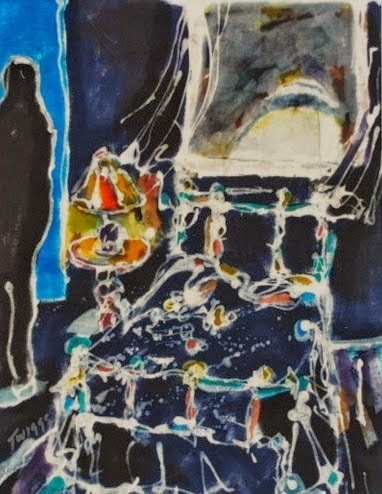
Sunday, November 30, 2008

if ARTwalk: Salon I & II: December 11- 24, 2008

For exhibition installation images, click here.


THE SALON I & II
Dec. 11 – 24, 2008
an exhibition at two Columbia, SC, locations:
Gallery 80808/Vista Studios
808 Lady Street
&
if ART Gallery
1223 Lincoln Street

Reception and ifART Walk: Thursday, Dec. 11, 5 – 10 p.m.
at and between both locations
Opening Hours:
Weekdays, 11 a.m. – 7 p.m.
Saturday, 11 a.m. – 5 p.m.
Sunday, 1 – 5 p.m.
& by appointment
Open Christmas Eve until 7 p.m.

For more information, contact Wim Roefs at if ART:
(803) 255-0068/ (803) 238-2351 – if-art-gallery@sc.twcbc.com

For its December 2008 exhibition, if ART Gallery presents The Salon I & II, an exhibition at two Columbia, SC, locations: if ART Gallery and Gallery 80808/Vista Studios. On Thursday, December 11, 2008, 5 – 10 p.m., if ART will hold opening receptions at both locations. The ifART Walk will be on Lady and Lincoln Streets, between both locations, which are around the corner from each other.

The exhibitions will present art by if ART Gallery artists, installed salon-style at both Gallery 80808 and if ART. Artists in the exhibitions include two new additions to if ART Gallery, Columbia ceramic artist Renee Rouillier and the prominent African-American collage and mixed-media artist Sam Middleton, an 81-year-old expatriate who has lived in the Netherlands since the early 1960s.

Other artists in the exhibition include Karel Appel, Aaron Baldwin, Jeri Burdick, Carl Blair, Lynn Chadwick, Steven Chapp, Stephen Chesley, Corneille, Jeff Donovan, Jacques Doucet, Phil Garrett, Herbert Gentry, Tonya Gregg, Jerry Harris, Bill Jackson, Sjaak Korsten, Peter Lenzo, Sam Middleton, Eric Miller, Dorothy Netherland, Marcelo Novo, Matt Overend, Anna Redwine, Paul Reed, Edward Rice, Silvia Rudolf, Kees Salentijn, Laura Spong, Tom Stanley, Christine Tedesco, Brown Thornton, Leo Twiggs, Bram van Velde, Katie Walker, Mike Williams, David Yaghjian, Paul Yanko and Don Zurlo.

Monday, September 29, 2008

Works of Art: Leo Twiggs

Works of art by Leo Twiggs are available at if ART Gallery, 1223 Lincoln Street, Columbia, SC.

Contact Wim Roefs at if-art-gallery@sc.twcbc.com or (803) 255-0068/(803) 238-2351.

Leo Twiggs, Targeted Man – That One, 2009, batik on

cotton, 9 x 8.5 in., $3,500/SOLD


Blue Night Crossing, 2012, batik on 

cotton, 10.5 x 8 in., $4,200


Remembering Mother Emanuel: 9, 2017, batik on cotton,

30 x 24 in., $18,500

Flag Crossing, 2016, batik on cotton,
16.5 x 10.5 in., $7,200

Old Flag Crossing, 2016, batik on cotton,

24 x 18 in., $11,000

Crossing With Two Cows, 2014, batik on cotton,
18 x 12 in., $8,500/SOLD
Black Interior, 2012, batik on cotton,
13 /12 x 10 1/4 in., $6,200
Blue Interior, 2012, batik on cotton,
13 1/2 x 10 1/4 in., $6,200


Reclining Fancy Dancer, 2012, batik on cotton,
21 x 24 in., $13,500

Targeted Man—Hooded, 2009
Batik on cotton
15 x 8 in., $7,200


Legacy, 2007
Batik on cotton, 16 ½ x 23 ½ in., $ 10,000/SOLD
Targeted Man- Meeting, 2008
Batik on cotton, 11 x 9 ½ in., $ 4,000/SOLD


County Fair, 2008, batik on cotton
18 ½ x 24 in., $ 11,000
Seeking Sanctuary #3, 2005
Batik on cotton, 25 x 24 1/2 in., $ 15,000
Targeted Man With Cow #1, 2011, mixed media on paper,
7 1/4 x 10 1/2 in., $850
Woman in a Blue Dress, 2014, batik on
cotton, 18 x 13 in., $8,750


Departure, 2012, batik on cotton,
9 1/2 x 7 1/2 in., $3,500
#2, 2012, batik on cotton, 17 1/2 x 13 in.,
$6,750 / SOLD
Anchored in the Spirit, 2014, batik on cotton, 
21 1/4 x 25 in., $14,000 


Targeted Man Watching, 2015,
batik on cotton, 6 1/2 x 4 1/2 in., $1,800


Sunday, September 28, 2008

Essay: Leo Twiggs

Leo Twiggs: American Original
By Wim Roefs

Not so long ago, painter Leo Twiggs took U.S. 178, then 378, from Orangeburg, S.C., to Athens, Ga. The back roads led through the small towns where, in the 1960s, the sight of rebel flags and Civil War monuments would trigger Twiggs’ exploration of the South’s Confederate legacy. As during those 1960s trips, Twiggs, perhaps the country’s best-known batik artist, was on his way to the University of Georgia. This time it was not to become that institution’s first African-American Ed.D. in art education, as he did in 1970. This time Twiggs went to see “Myths and Metaphors,” the first retrospective of his work, which opened in January 2004 at the Georgia Museum of Art on the UGA campus. 

The Confederacy features prominently in the exhibition, which in April 2006 completes its two-year tour at the South Carolina State Museum in Columbia. Images of ragged rebel flags, including a white one, are dominant in four paintings from 1970-71. They are part of Twiggs’ Commemoration series, in which he addressed the Confederate shadow over the South. During Civil War centennial celebrations in the early 1960s, with the Civil Rights Movement in full swing, South Carolina politicians had raised a rebel flag over the State Capitol in Columbia, claiming the state once again for its white population and its white population only. As South Carolinians in the 1990s again fought over the Confederate mark on their capitol, Twiggs revisited the theme. Through paintings of weathered rebel flags, also represented in the retrospective, he again denied whites a monopolistic hold on this icon of exclusiveness, simply by painting it.

The rebel flag also features in many of Twiggs most recent paintings. In Flag, of 2005, a small whitish flag with an overly dark cross is swallowed, or perhaps peaks through, a much larger cloud-like field of grayish purple. While the flag’s visual dominance suggests a Confederate presence, the flag’s smallness surely doesn’t suggest a triumphant one, nor does its whiteness or the dark cross through it. In his new High Cotton series, Twiggs plays with notions of societal hierarchy, placing flags of different colors, with the familiar cross, on top of a cotton field near the top of the canvas, next to a plantation home or a palmetto tree.

“What I like to do is change the way people perceive things,” Twiggs says. “The X of the Confederate flag is the Cross of St. Andrew, but it’s also a really great graphic design. Does it have the same power if you change its colors? Is it still the same thing? No one sees the Cross of St. Andrew or the cross on the Episcopalian logo as Confederate, so if you change the color of flags, it might create a certain ambiguity. And if you change the way you look at something, the thing you look at will change.”

Throughout his career, Twiggs has reminded those who need reminding that African Americans, too, are a part of the Confederate and neo-Confederate South. In Veterans with Flag, from 1970-71, a white man and black child sit underneath a rebel flag. In the Silent Crossings series of a few years back, a Cross of St. Andrew is stripped of Confederate trappings and looks like a railroad crossing sign, a common image in the rural South. The series, Twiggs says, symbolizes race issues that people have to overcome silently, as they linger without being discussed. Silent Crossing #5 includes a figure marked by a target and became the point of departure for Twiggs’ recent Moving Targets series. 

“Early on, we were moving targets,” Twiggs says, “especially black people who were successful in business or otherwise moved out of ‘their place.’ Often they were accused of corruption, castigated for things others would get away with, destroyed. Then comes 9/11, and not just African Americans but all of us become moving targets. I am from a generation that always was aware of being a moving target. Now everyone is aware of that.”

Twiggs is “an American original,” art historian Frank Martin has argued. He makes “formal and aesthetic contributions unlike those of any other American painter.” Twiggs, Martin wrote in the retrospective’s catalogue, has “an uncanny ability to reconcile a multiplicity of cultural traditions with integrity, while simultaneously offering insightful commentary regarding aesthetic, ethical, and social issues that are translated, with understated power, through his unique experience.”

Twiggs began to experiment with batik in the mid-1960s and within years became closely associated with the medium. In several 1970s exhibitions, Twiggs shared the stage with a who’s who of African-American art, including Jacob Lawrence, Lois Mailou Jones, Romare Bearden, Selma Burke, Richmond Barthe, John Biggers, Charles Alston and Hale Woodruff. Woodruff had been his teacher at New York University in the early 1960s. During the 1970s, Twiggs was included in books on African-American art by J. Edgar Atkinson, Samella Lewis and Elton Fax. He had solo museum exhibitions at North Carolina’s Asheville Museum, New York state’s Schenectady Museum, and the Studio Museum in Harlem.

Although Twiggs studied in Chicago and New York in the 1960s, he stayed put in his native South Carolina, in Orangeburg, far away from metropolitan art centers and major universities where reputations often are built and maintained. He focused on developing his art, his art department at South Carolina State University, his university’s museum and his home state’s art infrastructure. 

At S.C. State, where Twiggs taught from 1964 to 1998, the art program he led built a cadre of African-American art teachers for K-12, a first for South Carolina. He spearheaded the establishment of the university’s I. P. Stanback Museum and Planetarium and the university’s new fine arts building. Twiggs hopped on boards here and commissions there, making decisions about, say, his state’s arts commission, its art collection, its State Museum, the Guild of South Carolina Artists, and the Governor’s School for the Arts. Often as the token black fellow, he put black South Carolinians on the radar as artists, art administrators and audiences. In 1981, he was the first to receive as an individual South Carolina’s highest art award, the Elizabeth O’Neil Verner Governor’s Award for the Arts.

To do all Twiggs has done and keep his art as fresh as he has is almost impossible, says artist Benny Andrews, a Georgia native living in New York City. Fax called it “a near miracle” in 1978. “Someone of his stature,” says Andrews, who retired from Queens College at the City University of New York, “could have very easily gone to a white university as a chair of a department or a very solid professorship. They really were raiding those [smaller] schools, even Harvard and Yale and City University and all those kind of places. They were looking for people like him.” But Twiggs stayed at S.C. State, which had art courses but no department when he arrived. “I couldn’t wait,” he says, “to start an art department.” 

Twiggs was born in 1934 and raised in rural St. Stephen, north of Charleston and not far from Orangeburg. St. Stephen, Orangeburg, South Carolina, the South and especially the black community remained Twiggs’ home and inspiration. His art is about subjects, topics, issues and people from or close to his Southern upbringing and countryside home. But through familiar specifics, Twiggs addresses broader themes, be it black culture, including the blues, the relationship between generations, religion and spirituality, or his region’s lingering Confederate mindset.

“In a single work,” Martin wrote in the retrospective’s catalogue, “Twiggs may present Southern regional themes, allude to a realm of intuition, magic, and traditional African religious elements, offer autobiographical information, and evoke, without effort, an aesthetic linkage to the most advanced aspects of Abstract Expressionism.” Martin is the former curator of exhibitions and collections at S. C. State’s Stanback Museum and intimately familiar with Twiggs and his work. 

While Twiggs’ paintings are always of something, his images often don’t dominate as images but as shapes, lines and fields of color. As such, the paintings seldom are straightforward snapshots but abstracted tableaus that are at once symbolic and narrative, allowing for interpretation on different levels. 

Twiggs’ imagery, symbols and cast of characters include old and young folks, whom he deliberately links, as in 1984’s Extended Family Portrait, which, at 52 by 38 inches, is his largest painting. The figures, clustered just off-center, are simply colored-in contours, without facial features, whose ages are, in typical Twiggs fashion, suggested only by the size, shape and heaviness or lightness of their forms. 

South Carolina’s native Palmetto tree, a beach, and shacks appear in 1999’s Blues at the Beach, which seems to mock the sanitation of the blues, as in the House of Blues chain, for instance in nearby Myrtle Beach. In Blues at the Beach #5 of 2003, briefs-and-bikini-clad pinkish people lay around leisurely but starkly cut off from their darker surroundings, populated with distant, introverted and clothed figures looking away or in from out of bounds. The pinkish people lay under a dark cloud, literally and in their state of segregated bliss. 

Twiggs’ use of regional and cultural specifics to communicate universal concerns echoes Hale Woodruff’s approach. Black art, Woodruff argued, had to begin with a black image, but that image could be anything, from an environment, a problem, or the look on someone’s face. Despite this necessary departure, Woodruff argued, “if it’s worth its while, it’s also got to be universal in its broader impact and its presence.”

Twiggs’ Hurricane Hugo series isn’t only about bad weather but about the theme of man versus nature and the resilience of African Americans in the face of adversity. The series We Have Known Rivers, with an assist from poet Langston Hughes, refers to Twiggs’ great-grandmother being sold as a slave to a plantation “over the river,” as Twiggs’ mom would put it. It’s also about the Mississippi River of his father’s youth and the Ashley and Cooper rivers in Charleston, for many Africans the pathways from Charleston’s harbor to inland slavery. The series further symbolizes the African rivers where slaves learned to grow the rice they and their descendents then grew in Lowcountry South Carolina. “In a still larger sense,” Twiggs says, “the series is a tribute to human beings who began their journey to civilization along the rivers of the world.”

Twiggs’ recent Sanctuary series came about after his retrospective. “People kept asking me how I had managed over the years to keep the work so consistent despite my teaching job, being on boards, etcetera. I had no answer for that – you just do it. I had never seen all the work together, though, but when I did in the retrospective I realized that my work was my sanctuary. That’s where I could go into myself, work on a piece, walk away from it to let it dry, do what I had to do elsewhere, then come back to it later and pick up where I left off. That prevented inconsistency.”

Tuesday, August 26, 2008

Biography: Leo Twiggs

LEO TWIGGS (American, b. 1934)

Leo Twiggs, from Orangeburg, S.C.is among South Carolina’s most revered and important artists, arts educators and arts administrators of the past 50 years. His recent series of paintings inspired by the 2015 Charleston Massacre at Emanuel AME church has traveled extensively through the Carolinas. In 1980, Twiggs became the first visual artist to receive South Carolina’s Elizabeth O’Neill Verner Governor’s Award for the Arts. His 2004 career retrospective, accompanied by a catalogue, opened at the Georgia Museum of Art and traveled to the Gibbes Museum in Charleston, S.C., the Greenville County (S.C.) Museum of Art, the Delta Fine Arts Center in Winston Salem, N.C., and the South Carolina State Museum in Columbia. Twiggs has had more than 70 solo exhibitions, the largest being Civil/Uncivil: The Art Of Leo Twiggs at the City Gallery at Waterfront Park in Charleston, S.C., in 2011. His work was selected for the South Carolina State Museum’s 1999 millennium exhibition 100 Years, 100 Artists. Among the many other places where Twiggs has exhibited are New York City’s Studio Museum in Harlem; the Schenectady (N.Y.) Museum; the Palazzo Venezia in Rome, Italy; the Herbert F. Johnson Museum at Cornell University, Ithaca N.Y.; the Mississippi Museum of Art; and the American Crafts Museum in New York. Twiggs’ 1997 exhibition, Commemoration Revisited, a return to paintings of tattered images of Confederate flags 25 years earlier,received national attention. Already during the 1970s, his work was included in several national exhibitions representing a who’s who of African-American art. 
            Twiggs’ career and body of work is extensively documented in the 320-page, heavily illustrated, 2011 book Messages From Home: The Art Of Leo Twiggs(Orangeburg, SC: Claflin University Press). He is featured in dozens of books, articles and other publications, including Elton Fax’s 1977 book Black Artists of the New Generation; the Studio Museum’s 1978 catalogue Leo Twiggs: Down HomeLandscape; Samella Lewis’ 1990 book African American Arts and Artists; Amalia K. Amaki’s A Century of African American Art, 2004; and the 2006 if ART catalogue Leo Twiggs: Toward Another Retrospective.

            Twiggs was born in 1934 in St. Stephen, S.C.  In 1956, he received his B.A. Summa Cum Laude from Claflin University in Orangeburg, S.C. In 1961, he studied at the Art Institute of Chicago, in 1964 earned his MA from New York University, and in 1971was the first African-American to receive a doctorate in art education from the University of Georgia. Formerly a distinguished professor of art and executive director of the I.P. Stanback Museum and Planetarium at South Carolina State University in Orangeburg, S.C., Twiggs is S.C. State professor emeritus and distinguished artist-in-residence at Claflin University. 

Friday, February 15, 2008

The Inventory: February 15-26, 2008

Moving Targets, 2006
Batik on cotton
6 x 7 3/4 in
$1,950


if ART
presents at
Gallery 80808/Vista Studios
808 Lady St., Columbia, S.C.

THE INVENTORY:
A Group Show of if ART artists

Feb. 15 – 26, 2008

Artists’ Reception: Friday, Feb. 15, 5 – 10 p.m.

Opening Hours:
Saturdays, 11 a.m. – 5 p.m.
Sundays, 1 – 5 p.m.
Weekdays, 11 a.m. – 7 p.m. and by appointment

For more information, contact Wim Roefs at if ART:
(803) 238-2351 – wroefs@sc.rr.com

For its February exhibition, if ART presents The Inventory, a group exhibition of artists from if ART Gallery. The show will consist of many new works by if ART artists as well as older pieces from the gallery’s inventory.

Included in the show will be work by Columbia artists Jeff Donovan, Mary Gilkerson, Marcelo Novo, Anna Redwine and David Yaghjian. Other South Carolina artists include Carl Blair, Jeri Burdick, Phil Garrett, Bill Jackson, Peter Lenzo, Dorothy Netherland, Matt Overend, Edward Rice, Tom Stanley, Christine Tedesco, H. Brown Thornton, Leo Twiggs, Katie Walker and Paul Yanko. Furthermore, the show will present work by former South Carolina residents Tonya Gregg, Eric Miller and Andy Moon. Also included are California collage artist Jerry Harris, Dutch painter Kees Salentijn and German artists Roland Albert, Klaus Hartmann and Silvia Rudolf.

Thursday, November 8, 2007

Resume: Leo Twiggs

Leo Twiggs was born in St. Stephen, South Carolina. He received his BA Summa Cum Laude from Claflin University, later studied at the Art Institute of Chicago and received his MA from New York University where he studied with Hale Woodruff, the acclaimed African American painter and muralist. He received his doctorate in Art Education from the University of Georgia. As Professor of Art at South Carolina State University, he developed the Art Department and I.P. Stanback Museum. Twiggs was named Professor Emeritus in 2000.

In 1981, he received the Verner Award (Governor’s trophy) for outstanding individual contributions to the arts in South Carolina, the first visual artist so honored.

Twiggs’ paintings are done in a unique, innovative batik technique that he developed after several years of experimenting with the traditional medium. He has had over 60 one-man shows and his work has received international recognition, with exhibits at the Studio Museum and the American Crafts Museum in New York and in U. S. Embassies in Rome, Dakar and Togoland among others. His work has been widely published in art textbooks and featured in several television documentaries. In 2002, he was selected to design an ornament for the White House Christmas tree.

Selected Listings:
Myths and Metaphors: The Art of Leo Twiggs: Georgia Museum of Art,
University of Georgia, 2004.
Ragan, Rosalind: Art Talk, Glencoe Publishing, 1994.
Ragan, Rosalind: Art Connections Glencoe Publishing, 1997.
Catalogue: Art in the American Embassy, Dacca.
Who's Who in American Art, 1986-Present.
Ebony Magazine, September 1988.
Lewis, Samella: Art: African American, New York: Harcourt Brace and World, 1991
The St. James Guide to Black Artists: Thomas Riggs, Ed.
New York: St. James Press, 1997

Selected Exhibitions:
Studio Museum: New York
Schenectady Museum: New York
Herbert F. Johnson Museum: Cornell University, Ithaca, N.Y.
Harrison Museum: Roanoke, VA.
Palazzo Venezia: Rome, Italy
Hampton III Gallery: Greenville, SC.
Art in U.S. Embassies: Dakar, Togo land, Rome, Sierra Leone
Uncommon Beauty in Common Objects: African American Crafts, A Traveling Exhibition - American Craft Museum, New York; Dallas Tex.; Oakland, Calif.; Atlanta, GA.; Washington, DC.
The Gibbes Museum, Charleston, S.C. (Spoleto USA) 2004
The Georgia Museum of Art University of Georgia
The Greenville Museum of Art: Greenville, S. C.
The Milton Rhodes Gallery: Winston Salem, N. C.

Monday, August 27, 2007

The Fame Factor: September 7-18, 2007

if ART PRESENTS AT GALLERY 80808/VISTA STUDIOS:

THE FAME FACTOR

Featuring art by:

Benny Andrews (American, 1930-2006) – Karel Appel (Dutch, 1921-2006) – Lynn Chadwick (British, 1914-2003) – Corneille (Dutch, b. 1922) – Jacques Doucet (French, 1924-1994) – John Hultberg (American, 1922-2005) – Richard Hunt (American, b. 1935) – Wilfredo Lam (Cuban, 1902-1982) – Ibram Lassaw (American, 1913-2003) – Ger Lataster (Dutch, b. 1920) – Lucebert (Dutch, 1924-1994) – Sam Middleton (American, b. 1927) ¬– Joan Mitchell (American, 1925-1992) – Hannes Postma (Dutch, b. 1933) – Reinhoud (Belgian, 1928-2007) – Paul Reed (American, b. 1919) – Edward Rice (American, b. 1953) – Kees Salentijn (Dutch, b. 1947) – Virginia Scotchie (American, b. 1959) – Leo Twiggs (American, b. 1934) – Bram van Velde (Dutch, 1895-1981)

September 7 – 18, 2007

Opening Reception: Friday, Sept. 7, 2007, 5:00 – 10:00 PM

Opening Hours: Weekdays, 11:00 AM – 7:00 PM; Sat., 11:00 AM – 5:00 PM;
Sun, 1:00 – 5:00 PM


In September, work by world-famous artists such as Joan Mitchell, Karel Appel, Lynn Chadwick, Wilfredo Lam and Bram van Velde will be in The Fame Factor, a group show at Gallery 80808/Vista Studios in Columbia organized by if ART Gallery. The exhibition also will include if ART Gallery artists Leo Twiggs, Edward Rice, Kees Salentijn,Virginia Scotchie, Laura Spong and Paul Reed. The Fame Factor will explore the concept of fame, especially the relativity of fame.

The exhibition opens September 7 with a reception from 5:00 – 10:00 p.m. and runs through September 18. Opening hours for Gallery 80808/Vista Studios will be expanded during the if ART exhibition. They will be weekdays, 11:00 a.m. – 7:00 p.m.; Sat., 11:00 a.m. – 5:00 p.m.; Sun, 1:00 – 5:00 p.m.

Other American artists with national and even international reputations in the show are Richard Hunt, Benny Andrews, Ibram Lassaw, Paul Reed, John Hultberg and Sam Middleton, an American artist who has lived in the Netherlands since the early 1960s. Dutch artists with international fame in addition to Appel and Van Velde will be Corneille, Ger Lataster, Hannes Postma, Kees Salentijn and Lucebert. Furthermore, the show will present French artist Jacques Doucet and Belgian artist Reinhoud.

Reinhoud and Doucet both were part of the legendary CoBrA group of Northern European artists from the late 1940s and 1950s, which also included Appel, Corneille and Lucebert. “CoBrA” stands for Copenhagen, Brussels and Amsterdam, the cities or origin of most of the major figures in the group. Another artist in the show, Wilfredo Lam, a Cuban artist who had a vast international reach, exhibited once with CoBrA, in the early 1950s, though he was not a member. All of these artists are in the collections of major American museums. Dutchman Salentijn works in a post-CoBrA style.

Hunt, Lassaw, Chadwick and Reinhoud are sculptors. All will be represented in the exhibition with limited-edition lithographs. Hunt, from Chicago, is one of the country’s most famous living sculptors, in part for his many public sculptures. Lassaw was one of the main sculptors in the New York School and a core figure on the city’s 1940s-1950s Abstract Expressionist scene. Chadwick is one of the most prominent figures among British sculptors of the generation of Henry Moore and Barbara Hepworth.

Sam Middleton, born in Harlem, NY, but living in the Netherlands, is known for his collages inspired by jazz; the exhibition will show some of his silkscreens. Lataster is one of the Netherlands’ most prominent Abstract-Expressionist painters; his work is in several major American museums. Postma established a big reputation in Europe in the 1960s with his etchings and aquatints, some of which will be in the show. Bram van Velde, who spent most of life and career in Paris, is a legendary figure among mid-20th-century European abstractionists.

Hultberg was part of the New York School scene but subsequently moved to California. Andrews was from Georgia but built his career in New York City, becoming one of the country’s most prominent African-American artists, who increasingly gained traction in the wider art community. Reed was with Kenneth Noland, Morris Louis and Gene Davis among the original Washington Color Field painters of the 1960s. Mitchell is simply one of the most famous Abstract-Expressionist painters.

Twiggs, from Orangeburg, S.C., most likely is the country’s most prominent pioneer with batik as a contemporary art medium. Scotchie is a ceramist with an international reputation who teaches at the University of South Carolina. Rice, from North Augusta, S.C., is represented in many museums in the Southeast. Spong’s reputation has grown by leaps in recent years and is now among South Carolina’s best-known abstract painters.

“The idea of the show is to explore how relative fame is,” if ART Wim Roefs said. “Several feet worth of books and catalogues on Appel, and a few feet on Mitchell, don’t change the fact that among people attending this show, Laura Spong is probably better known – and she makes do with a single 32-page catalogue. Leo Twiggs also is better known here than Appel and Mitchell. Someone like Van Velde is legendary in Europe. Though he had New York gallery shows in the United States, and though his work is in many major American museums, he is at best obscure around here. In general, of course, a lot of famous European artists aren’t well-known in the United States.”

“Lassaw really was one of the major sculptors among Abstract Expressionists, but, of course, sculptors, except for David Smith, played third fiddle in the movement compared to the painters. Reed was one of six artists in the first nationally traveling exhibition of Washington Color Field painters, with Kenneth Noland and Morris Louis, and he makes the art-history books. Still, he’s mainly known among art insiders, though the renewed recent appreciation of color-field painting has giving him new exposure, too.”